These are my notes for “teaching, researching, doing,” a short talk I gave to the Washington State University English graduate student series on “Literature Pedagogy.” I was asked to present with Augusta Rohrbach on the “futures” of literary study, and I decided to focus on pedagogy as — itself — the future of literary study.
Leeann and Aree have been wonderful in putting together this series, mostly because I think it is both an urgent discussion and one that isn’t really taking place in campuses across the United States. Literary studies doesn’t have a strong connection to pedagogy or critical reflection on teaching, and I’m happy to see this program take a leadership role in starting these important conversations. I’d also like to thank Augusta, who is really a pioneer in this field as well. She’s a really great advocate for things I feel are on the horizon in literary studies and the digital humanities.
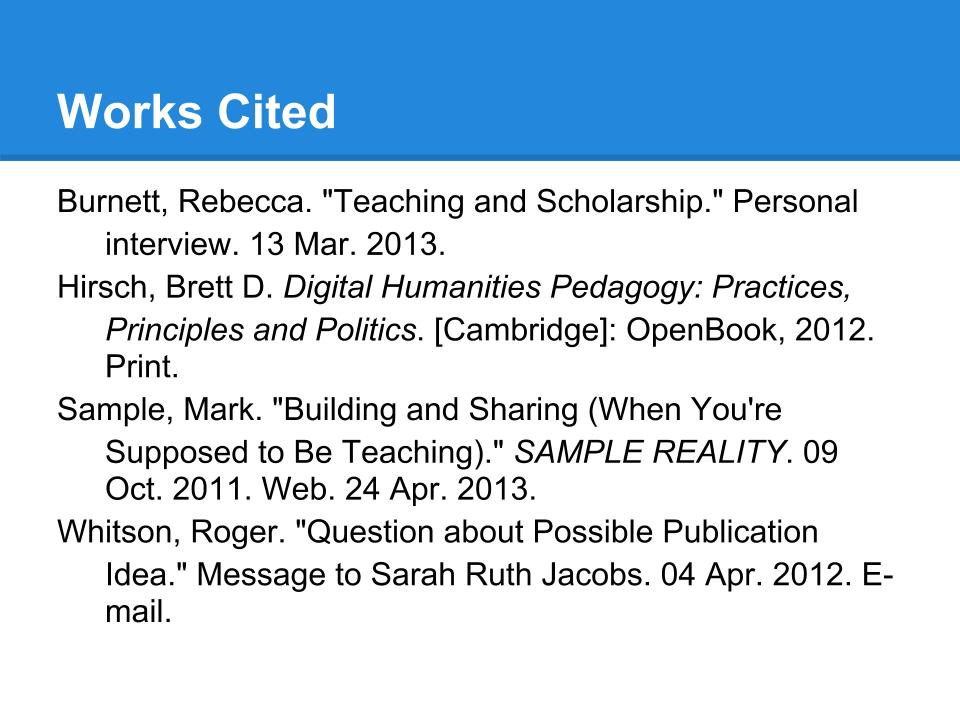
So, I’d like to start out with a quote from Rebecca Burnett, the director of the Writing and Communication program at Georgia Tech. I like this quote because to talk adequately about the “future” of literary studies, I feel it is important to focus on the core of who we are and what we do. From my perspective, I’m a teacher first. I’m here to teach. And that core informs the kinds of scholarship and the types of activities that I do.
 When I was a graduate student, it was very difficult for me to find good mentors who would teach me what it meant to be a teacher. Of course, I had the introduction to teaching writing course, but that was mostly theory in my Master’s program. And I was encouraged to think of my primary purpose as getting my degrees and publishing — rather than teaching. This is one of the reasons why it’s so important to continue these kinds of conversations. Literary scholars have a voice — or at least should have a more present voice in the realm of teaching. Unfortunately, we rarely exercise that voice. Why?
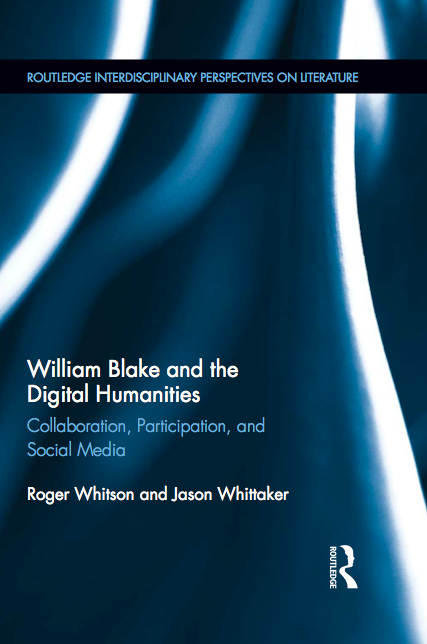
 Those of us in literary studies are often told to “bracket” our teaching. We’re told that it isn’t the same as our research. But that’s really a false dichotomy. One of the most interesting moments during my master’s program was when I attended a job talk, and a candidate was asked how he would incorporate his highly theoretical discussion into his teaching. He couldn’t answer the question, and he didn’t get the job. Hirsch’s argument here is directed toward the digital humanities, but I think it goes equally for literary studies. BTW, this book great, available for free, and you can find it pretty easily.
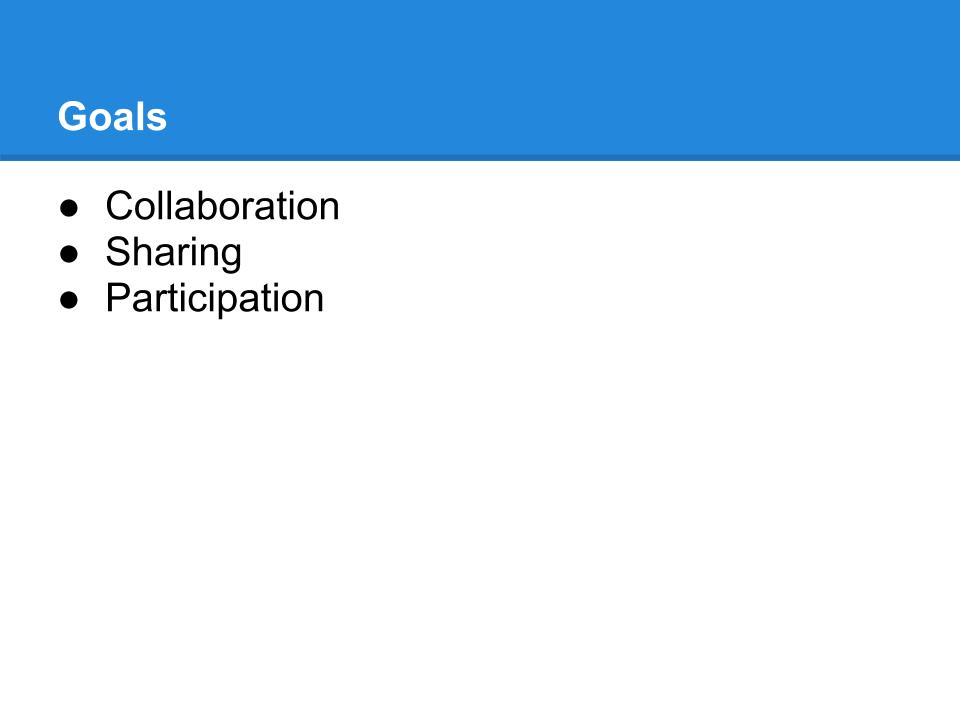
I don’t see any big distinction between my teaching and my scholarship. I do feel that, to be an effective teacher, I have to participate in conversations about my teaching — and this includes writing peer-reviewed scholarship on teaching. Further, I’m a big believer in collaboration, sharing, and participation: three values that I have derived from my work within the digital humanities community. Thus, I try to make my pedagogy and scholarship publicly available whenever I can. More importantly, I want faculty to visit my classes — all the time. I want to have my students show off their work. Why? Because I’m convinced that we do better work when we think together. I’m a better teacher if a colleague can point out ways for me to improve.
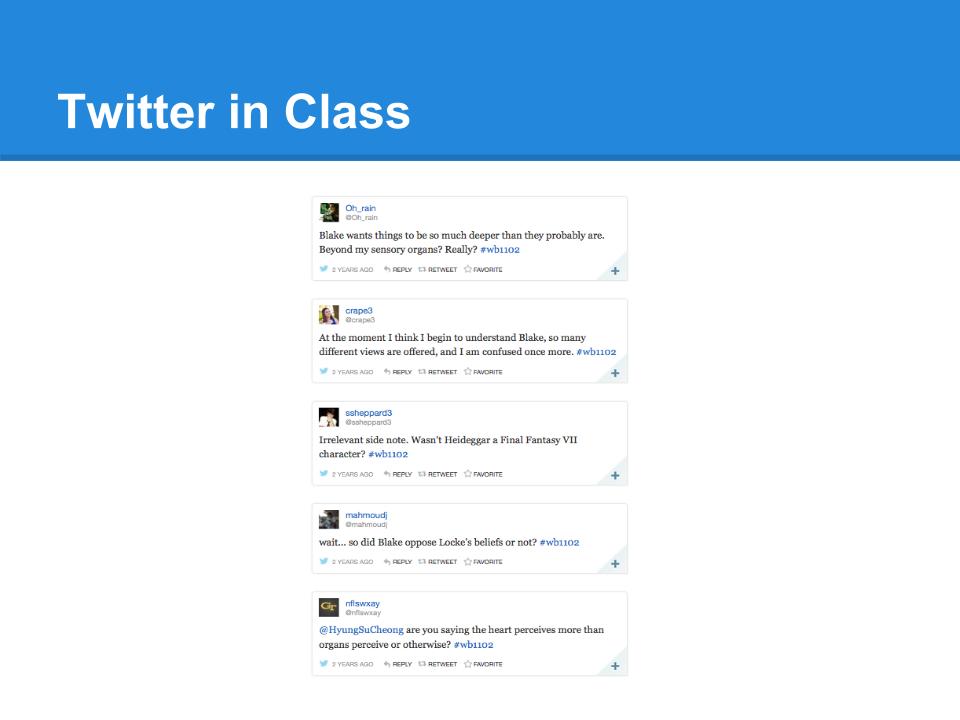
I try to make my courses more public by having my students engage in a Twitter backchannel in class. They are asked to tweet at least three times per class and three times per week outside of class. When it’s effective, and its effectiveness varies from class to class, you create an environment that is highly collaborative, in which readings are enlivened and enriched by the collective intelligence of the class, and where spontaneous conversations can show students the power of public work.
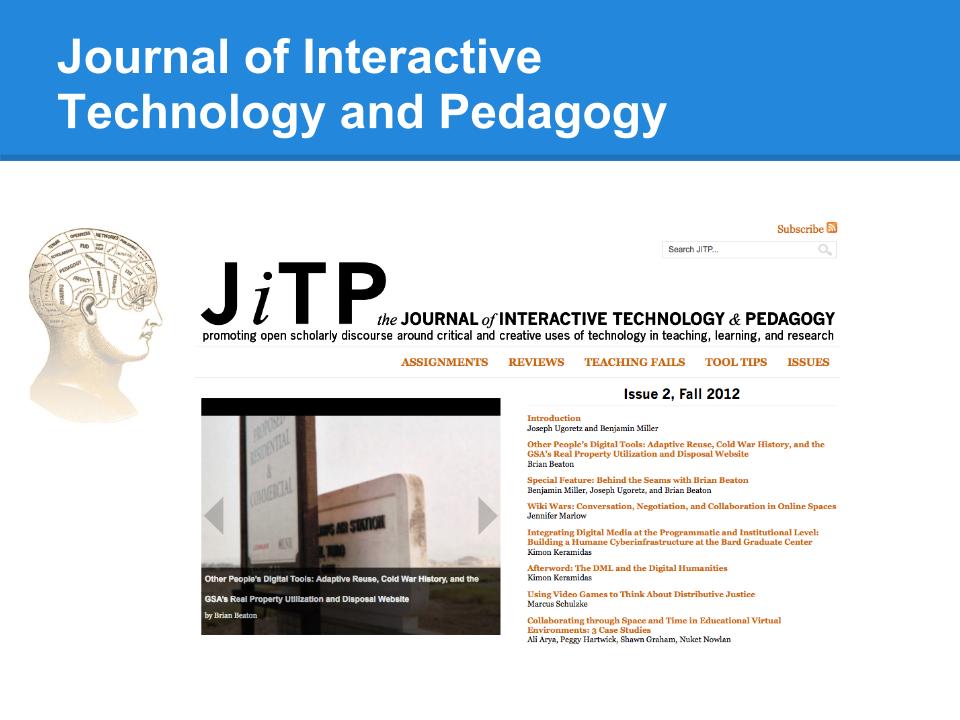
I’ve also had my courses collaborate with editors Amanda Licastro and Kimon Keramidas from The Journal of Interactive Technology and Pedagogy in a course focused on changes in reading, editing, and publishing during the nineteenth century. The idea, for me, was to merge (in a uniquely literary way) the worlds of culture and creativity. We studied not only the rhetoric of new forms of media, but the parallels between Nicholas Carr lamenting about whether Google is making us stupid and the fears of nineteenth-century literary critics like Margaret Oliphant about the emergence of cheap penny dreadfuls stupifying the British reading public. Rhetoric always exists within a history and a culture, and literary studies can help add those elements to traditional questions about writing and composition.
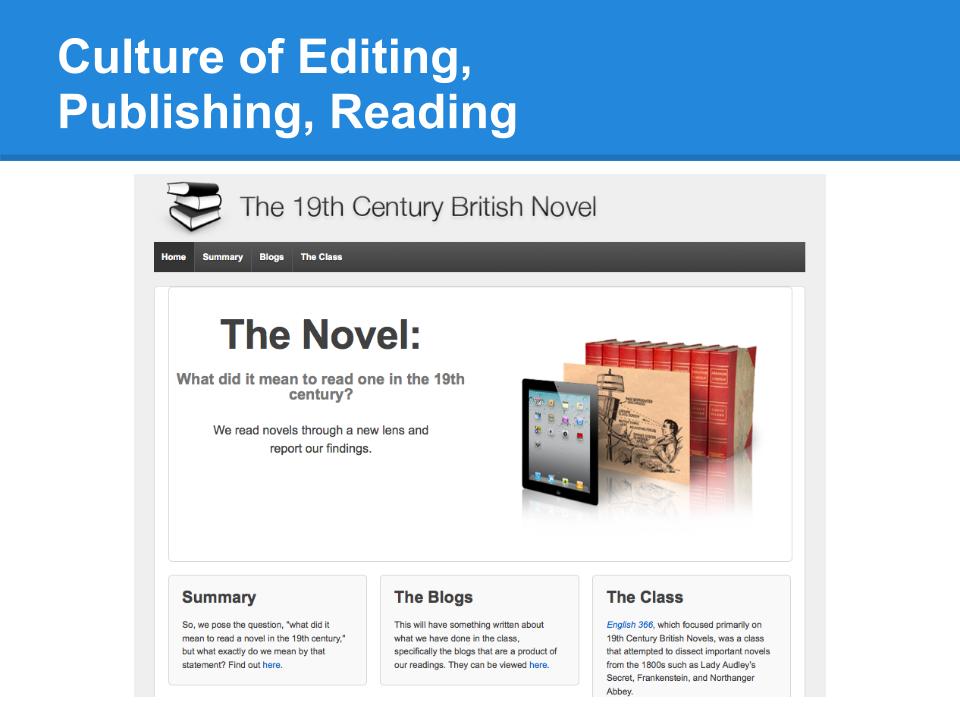
I was interested in this question of what it meant to have my students write for a public audience. Many digital humanities scholars make a gesture towards creating public work, yet few of them really analyze what that means — and what role history and literature have in shaping different kinds of publics. Students wrote blogs throughout the semester, but were then asked to pick the four best blogs to feature on the site. They also created criteria that made especially successful blog posts and voted on those criteria in class. The effect was to emphasize both the new rhetorical forms emerging out of social media (for example, how do you construct content that can be circulated in many different contexts?) balanced with a more traditional editorial model that many journals still use.
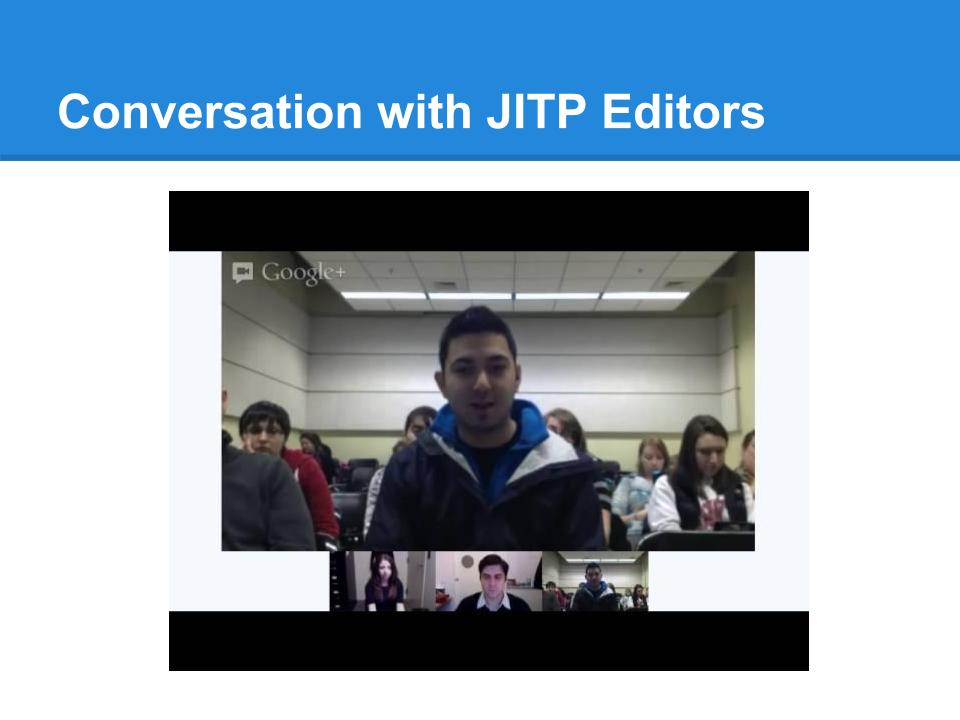
[show youtube video from 10:10-13:45] - The culmination of the course was 1) an hour-long conversation with the JITP editors about the issues emerging from their design; and 2) a publication that promotes student work and discusses the role of editors in teaching undergraduates. This conversation, from the final Google Hangout I had with Amanda, Kimon, and the students underscored some of the interesting design conversations that emerged from the site.
I suggest that students have the ability to publish, that they can form part of your scholarship, and that your teaching can become an interesting test-bed for many of your scholarly ideas. Mark Sample has something interesting to say about the emergence of digital technology and its impact on teaching. “The promise of the digital is not in the way it allows us to ask new questions because of digital tools or because of new methodologies made possible by those tools,” Sample argues, “The promise is in the way the digital reshapes the representation, sharing, and discussion of knowledge.” I’d add that the digital isn’t simply important for making new scholarship, it shows us that whatever distinction we’ve made between scholarship and teaching is simply facile. We can be teachers by engaging in critical and thoughtful scholarly conversations about pedagogy, and we can include our students as active participants in those conversations.
Thanks!