
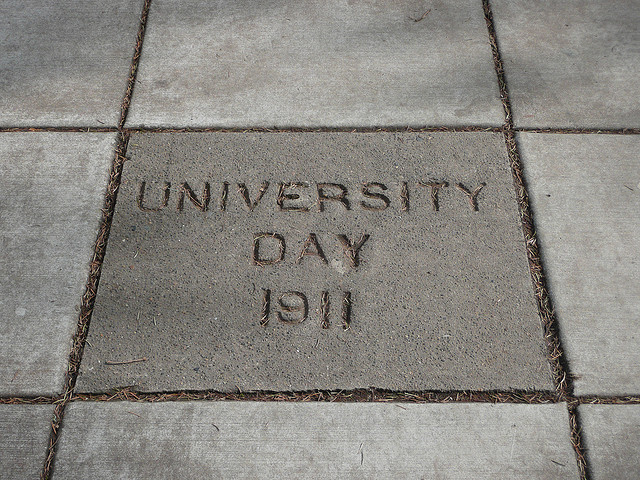
University Day 1911 by Jeff Ozvold, CC-BY
I got this idea from Richard Menke’s recent Facebook post:
“Help! A recent former student tells me she is ‘interested in graduate school’—in particular, in attending a graduate program in English at one of the universities whose football teams she likes.”
What do we do when our favorite students, that star of our most beloved class who would talk when no one else would, asks us about graduate school? I want to preface this by saying that I believe in graduate school in the humanities. I feel this is the most important time for the humanities to have bright young thinkers ready to change our disciplines. But I’m not so sure that the humanities are a great place for these people right now, since tenure-track job prospects continue to be bleak and many graduate programs continue to prepare their students almost exclusively for tenure-track jobs.
So, instead of going, as one of the responders said, “full Pannapacker” (I didn’t know that was a phrase, but Bill definitely has a more nuanced position than that these days), I say we perform a graduate school audit. Give the aforesaid amazing student the following questions, and reserve your recommendation letter until they do so.
1. What is your project? How do you justify studying “X,” given the current state of the job market?
The most successful graduate students have some sense of their project and the marketability of their project. If s/he wants to study a particularly saturated field, ask them how they plan on contributing something original to the field? Tell them that it is also important to tie their work to potential non-academic and #altac jobs, rather than just look at the tenure-track. The project needs to be compelling, original, and tied to the fields that look the most promising at the present time. It should also have some awareness of technology, even if it doesn’t venture into the digital humanities. My chair recently told me that we’d probably be looking increasingly for candidates that had some investment in technology going forward, and that seems like a pretty good idea to me.
2. How are you going to be funded?
Often-times, this is a particularly difficult question for undergraduates to answer, unless they put themselves through undergrad. I remember getting $1,000.00/month when I started as a Master’s student and believing that was a lot of money. Of course, everything changed when I started supplementing this income with: first, credit cards and then student loans. I also remember being somewhat jealous of the graduates who received fellowships for their research. Teaching Assistantships aren’t the end of the world, but they will certainly leave less room for research. If the student can’t get a full ride plus a stipend of at least $15K, I’d ask them to tell me how they plan on living on less. How will they afford the books required by their courses? Will they have a car? What about food?
3. What’s your plan after graduating?
I had originally planned on naming this the “backup” plan, but increasingly graduate students are going to need to see non-academic and #altac positions as a possibility as, or even more, likely as the plan to become a tenure-track professor. How does the student’s project connect to their plans post-graduation? Will the student look for postdocs? How will these postdocs help the student get to their goal? Have the student come up with at least three or four realistic plans for graduate school, and then tell them that they must prepare for all of these plans.
Suggest
Suggest to the student that they take an internship at one of the administrative offices on campus or in the library. Have them work with digital archives at some point in their careers. For me, the ideal graduate student project is one that can interface with many different concerns across campus. Professors and professionals are expected to wear many hats these days. A single, highly specialized project is not enough anymore. If the student has an original, focused, compelling project — give them some suggestions on how to open their work to various constituencies on or outside of campus.
If, at any point, the student asks “did you do this during your graduate school experience?” Admit that you did not. Admit that you were lucky and that the requirements for graduate school weren’t the same when you finished your degree. But, then tell them that both the academy and graduate school are very different than they were when you got your job.
Do you have any other suggestions for a graduate student audit? Maybe you should have them come in with a list of potential schools and backups? What else? Leave suggestions in the comments.
Addendum:
Karen Kelsky has many great resources for graduate students both going on the job market and considering graduate school. For instance, she notes that “even if you [graduate students] are ‘fully funded,’ the quote-unquote full funding is inadequate to support most people’s actual expenses, particularly if they have a partner, children, health challenge, or any other responsibilities.” She also mentions several things I agree with [my comments are in brackets]:
1. Only accept the very best programs [as she notes, these aren't necessarily the Ivy Leagues]
2. Avoid second and third-tier programs like the plague [or be very aware of placement rates, where graduates are placed, and their attitude toward non-academic and #alt-ac training]
3. Align yourself with an advisor who is at the top of their game AND (not “or”) who is genuinely invested in your success [the latter is not as easy to determine by yourself, so you will have to do quite a bit of research]
4. Understand that you will be judged solely on your output (grants, publications, famous recommenders) rather than the brilliance of your ideas [here it might be useful to pick an advisor who can help you get publications from the beginning of your graduate career, have at least four articles "in production" at any given time]
5. Understand that graduate school is a means to a job [I completely agree with what she's saying here. I'd only add that you consider graduate school an actual job, rather than think of yourselves as being a student and not having an actual job. My graduate school tried to get students to think of themselves as students because it makes it easier for them to accept poor wages, little to no benefits, etc. if they think of it as a temporary situation. Think of the tenure-track as a promotion. Going to a school with a strong graduate student union can help with some of these issues]
The overall message is that neither you nor your student should take the decision of whether to go to graduate school lightly. There should be multiple plans and multiple back-up plans that ensure some kind of success after 10 hard years of researching and teaching.
-
Chuck Rybak
-
http://www.rogerwhitson.net/ Roger Whitson
-
Chuck Rybak
-
http://www.rogerwhitson.net/ Roger Whitson
-
-
-