
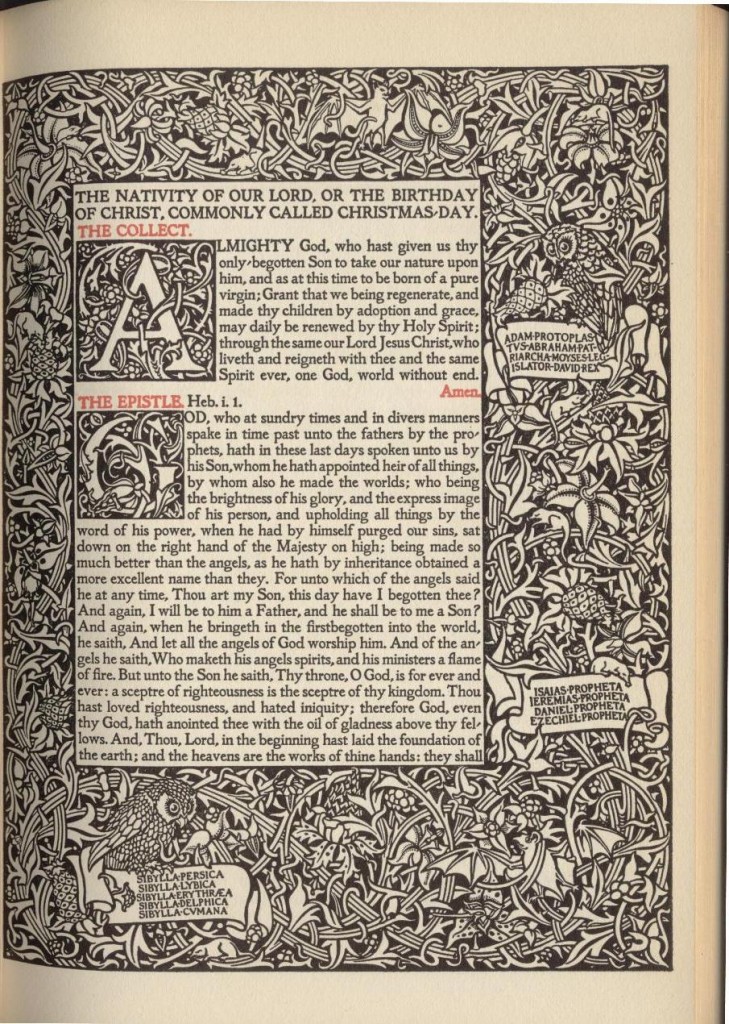
Page of Altar Book by Berkley Updike.
In the introduction to How to Do Things with Books in Victorian Britain, Leah Price asks “what meanings do books make even, or especially, when they go unread?” This course will explore the nineteenth century by dramatizing the clash between an emerging image of the reading individual as a national subject and the sense of the book as an object: as a class-marker, a weapon, an organism with an inner life, a talisman, or a piece of trash. Along the way, we will see how the insights of new materialism, actor-network theory, and the digital humanities can help us understand approaches to appreciating the materiality of nineteenth-century literature. What is the difference, in other words, between books and text? How does the bildingsroman participate in the (temporary?) triumph of subjectivity as a mode of understanding being? What are the forgotten ways nineteenth-century authors tried to produce alternatives to cheaply-printed texts like the penny dreadful?
Note that the title of this course is written in the present tense. This means that I will ask you to complete an assignment sequence that culminates in doing something with nineteenth-century British literature, including some form of what Matt Ratto has called “critical making:” the construction of a made-object that reflects a critically-informed, research-oriented engagement with the nineteenth century. For us, this will take the form of a critical edition of a text from the nineteenth century: either as a bound book, a digital archive, or some other scholarly object. The assignment sequence includes a prospectus, mid-term presentation, a final made-object or digital project, and a 10-page critical introduction to your object. I will also ask for frequent engagement with social media and in-class participation.
Primary Sources
- Jane Austen. Northanger Abbey. Peterborough: Broadview, 2002.
- William Blake. Milton: A Poem in 2 Books.
- William Godwin. Caleb Williams. Peterborough: Broadview, 2000.
- William Wordsworth. The Prelude. London: Penguin, 2004.
- Charlotte Bronte. Villette. Peterborough: Broadview, 2005.
- Henry Mayhew. London Labour and the London Poor vol. 1: The London Street Folk. Oxford: Oxford UP, 2010.
- Wilke Collins. The Moonstone. Oxfordshire: Oxford UP, 1999.
Secondary Sources
- Nancy Armstrong. How Novels Think: The Limits of Individualism. New York: Columbia UP, 2006.
- Simon Eliot and Jonathan Rose. “Some Non-Textual Uses of Books.” A Companion to the History of the Book. London: Wiley-Blackwell, 2008. 480-492.
- Roger Chartier, “Communities of Readers.” The Order of Books. Stanford: Stanford UP, 1992.
- Graham Harman, “On Vicarious Causation.” Collapse II: Speculative Realism. London: Urbanomic, 2007. 187-221.
- Holbrook Jackson. The Anatomy of Bibliomania. New York: Nabu Press, 1930.
- Garnet Hertz and Jussi Parikka, “Zombie Media: Circuit Bending Media Archaeology into an Art Method.” Leonardo. 45.5 (2012): 424-30.
- Bruno Latour, “Objects Too Have Agency.” Reassembling the Social: An Introduction to Actor-Network Theory. Oxford: Oxford UP, 63-86.
- Reza Negarestani, “The Corpse Bride: Thinking with Nigredo.” Collapse IV: Concept Horror. London: Urbanomic, 2008. 129-60.
- Quentin Meillassoux, “Ancestrality,” After Finitude: An Essay on the Necessity of Contingency. London: Continuum, 2008. 1-27.
- Nick Montfort, “Continuous Paper: The Early Materiality and Workings of Electronic Literature.” NickM. 28 December 2004.
- Mark Mossman. “Representations of the Abnormal Body in The Moonstone.” Victorian Literature and Culture. 37.2 (2009): 483-500.
- Jussi Parikka, “Media Archaeology and New Materialism.” What is Media Archaeology? London: Polity, 2012. 63-90.
- Leah Price. How to Do Things with Books in Victorian Britain. Princeton: Princeton UP, 2012.
- Eugene Thacker, “Nine Disputato on the Horror of Theology.” In the Dust of This Planet: Horror of Philosophy vol. 1. Alresford: Zero Books, 2011. 98-133.