I’m writing this post for a number of reasons, not the least of which is an MLA report that recently gained a number of detractors from various circles within the English Department. Rhetoric and composition scholars are (rightly) pointing out that writing pedagogy has long adopted a number of these reforms. Graduate/adjunct advocates are wondering how students can prepare for all of these requirements. Scholars in literary studies are wondering what their field even means after the reforms. Let me say at the outset that I do not think that the MLA report is perfect.
But English departments really need the MLA report.
I was astonished to find this exchange on Rebecca Schuman’s critique of the report, which underlines precisely why it is so urgently needed. Schuman critiques the stipulation on the report to “Reimagine the Dissertation,” with the idea that new forms of the dissertation can only be condescending. “You should not be expected to write a Real Dissertation either. Why don’t you just do an interpretive dance? That sounds neat.” One of her commenters, Carlotte Canning, said the following:
I. Dance. Why is dance the “go to” field when one wants to sneer at something? There’s no such thing as “interpretative dance,” but there is a lot of excellent work in that field. It might be better to ally yourselves with those of us in the arts, instead of using us to make a disdainful point.
Schuman responds that dance “would not–and should not–qualify as a dissertation in English Literature, because it is NOT THE RIGHT FIELD.” And yet, this response strikes me as precisely the wrong way to approach the challenges English has in the twenty-first century. Our discipline should be encouraging experimentation, not quashing it under assumptions of what the field “really” encompasses. Such rhetorical moves, as Ted Underwood has recently and painstakingly pointed out, are often the product of sheer neoconservative fantasy rather than any real understanding of the historical dimensions of our discipline. We certainly should not be ignoring the potential insights that could be found by directly confronting how a University might evaluate original research delivered as a performance.
My experiences at DHSI in the Physical Computation class have shown just how powerful an English degree allied with the arts could be. Jentery Sayers has challenged us to consider the intersection of programming, design, and ideologies of historical preservation by reconstructing a 1983 Atari Missile Command game desk using Raspberry Pi and Makey Makey.
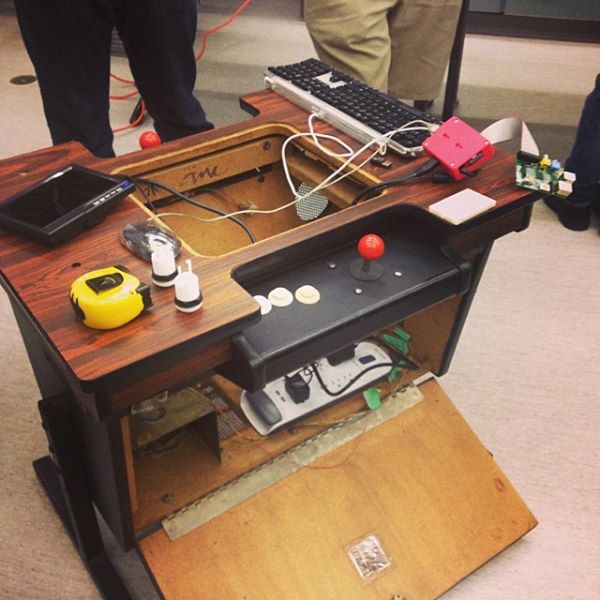
Now, on the one hand, I know many scholars would immediately point out the need for a critical approach to how Atari put together their games, what labor it entailed, how Atari’s own methods of production fed into Reagonomics, etc. All of these would be great projects. But there is quite a bit to understanding how power and history are constructed materially. You can write about TCP/IP Protocols, as Alexander Galloway does quite well, but should every technological response to these phenomena take the form of written dissertations?
I think we are leaving out quite a bit if we, as a discipline, point to something unusual and say “that’s not English.” And I, for one, would rather let go of an archaic disciplinary apparatus that forced its researchers and students to stick with papers and books while indenturing them to years of underpaid labor, than see it preserved under any kind of revisionist historical fantasy. We need the MLA report because too many people assume they know better than researchers who are trying to do something exciting in this discipline. I don’t feel that we should uncritically adopt all of its provisions, but the document fundamentally changes the stakes of conversations that have too long toiled under the weight of ignorance and assumed tradition.
I think Rebecca’s point is that the typical literary studies doctoral student is seeking a career that is roughly the same as his/her mentor’s. In turn the typical mentor has a stake in maintaining the status quo. And it’s not the super senior faculty members that are a stake now. It’s the 30/40-something grad students and professors, who are hoping for another 20+ years doing what they were trained to do (which is what their mentors were trained to do). Plus we should probably thrown in everyone who is in grad school and will enter grad school in this decade, because nothing will happen quickly enough to help those folks. It’s basically everyone who entered grad school in English after the Mosaic internet browser in 1994 (which is not a cause, but hardly coincidental either).
Of course it would have been hard to predict 2014 in 1994, but here we are nonetheless. I’m very much interested in critical making and DH widely, widely, conceived. I don’t imagine a grand future for the faculty-formerly-known-as-the-humanities, but what future there is probably addresses helping people learn to live in a globalized-digital culture just as our 20th century predecessors helped people learn to live in a nationalized-industrial culture. Then, one would have to factor in the larger change in higher education. There is a future where that kind of educating will need to be done and to do that educating some research will need to be done as well. What those careers will look like, how many there will be, how secure the jobs will be, and how well they will pay is really anyone’s guess. But it is hard for me to imagine this post-1994 group of literary scholars as being well-prepared as a group to meet that future.
Thanks Alex. I understand that feeling you are ascribing to Rebecca. And I agree that it is difficult to predict the future, even now. But I do think that multiplying the potential jobs our grads can fill in literary studies is important, particularly for those who start a program wanting to write about Modernism for the rest of their lives then realize that there aren’t many jobs there. I feel, if there are many TT jobs in the future, they should be focused on people who can bridge literary tradition to the globalized-digital culture you cite — if only to channel the enthusiasm many grads have for literature in a productive direction. See, for instance, Lori Emerson’s new book on computational interfaces, media archaeology, and electronic literature.
As I said, I don’t think the MLA Report was perfect. I’d like to see more direct advocacy for adjuncts. I mean, if they can create a statement boycotting Israeli institutions, I’m sure there can be a resolution calling for something closer to the living wage that Michael Berube listed last year. Also, Carolyn Betensky mentioned on Facebook creating more legitimate screening practices for adjuncts. That’s an interesting idea. Having said that (and noting the need, IMO, to reduce graduate programs), I feel the spirit of the MLA Report was important because there are many older full profs who either think DH is part of textual editing studies or ignore it entirely. They control many grad programs and advise students in ways that I feel are less than useful. So, having a document that you can present to graduate committees to say - yes - there are concrete ways we can better prepare our students for the markets they face is really powerful.